
 Login To Net Banking
Why open a savings account with FinoPay
FinoPay offers a unique "phygital" banking experience. This guide breaks down the Shubh zero-balance account, the 7.75% interest sweep-in facility, and how to use their 10 lakh merchant points for easy cash accessibility.
About the Blog
FinoPay is the digital banking app for Fino Payments Bank.1 Unlike traditional commercial banks (like HDFC or SBI), Fino operates as a Payments Bank, which means its regulatory structure and value proposition are different.
For a senior engineer, the decision to open an account here usually hinges on utility and accessibility rather than wealth accumulation (due to deposit limits).
Why Open an Account? (The Value Proposition)
-
Subscription-Based Zero Balance (Shubh Account)
-
The Model: Unlike traditional banks that punish you for non-maintenance of Minimum Average Balance (MAB), Fino offers a "Subscription Savings Account" (Shubh).4 You pay an annual fee (approx. ₹400-₹450), and the MAB requirement becomes Zero.
-
Use Case: Ideal as a secondary transaction account where you don't want to lock in capital just to avoid penalties.
-
-
Sweep-in Facility (High Interest Yield)
-
The Mechanism: As a Payments Bank, Fino has a deposit limit of ₹2 Lakh. To bypass this, they partner with Suryoday Small Finance Bank.
-
The Gain: Balances excess of ₹2 Lakh are automatically swept into a Fixed Deposit (FD) with the partner bank, earning interest rates up to 7.75% p.a. (significantly higher than standard savings rates of 2.75-3%).
-
-
Instant "Hatho-Hath" Debit Card
-
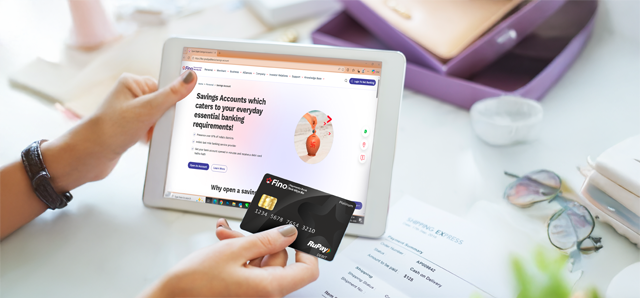
Speed: You get a personalized RuPay Platinum Debit card instantly upon account opening at a branch or merchant point. No waiting 7-10 days for mail delivery.
-
Feature: The RuPay Platinum card often includes insurance cover (up to ₹2 Lakh for accidental death/disability) and sometimes airport lounge access (varies by specific card issuer terms).
-
-
Accessibility & Merchant Network
-
Phygital Model: Fino focuses on "neighborhood banking." They have over 10 lakh merchant points (kirana stores, stationary shops) that act as micro-ATMs.
-
Utility: You can deposit and withdraw cash at these local shops without hunting for a specific bank ATM. This is excellent for remittances to family in Tier-2/3 cities.
-
Key Account Types
| Account Variant | Target Audience | Key Feature |
| Shubh Savings | General Users | Zero balance (Annual sub. fee apply), Instant Debit Card. |
| Bhavishya | Minors (10-18 yrs) | Digital banking for kids, usually zero balance. |
| Jan Savings | DBT Beneficiaries | Aadhaar seeding for govt subsidies, very low cost. |
| Pratham | Low Volume Users | Low MAB requirement, nominal charges. |
Technical & Functional Trade-offs
The Good (Pros):
-
Direct Benefit Transfer (DBT): Seamless Aadhaar seeding makes it reliable for receiving government subsidies.
-
UPI Integration: The FinoPay app handles UPI directly; good for keeping petty cash/daily spend separate from your primary salary account (security hygiene).
-
Accessibility: Works in remote areas where traditional ATMs are often out of service.
The Bad (Cons & Constraints):
-
Deposit Limit: You cannot hold more than ₹2 Lakh in the primary Fino ledger at the end of the day (regulatory cap for Payment Banks). Excess must move to the partner bank or be withdrawn.
-
Fees: Unlike premium accounts in private banks, Fino charges for many services (SMS alerts, annual subscription fees for zero-balance accounts, cash deposit charges beyond limits).
-
App UI/UX: The FinoPay app is functional but may feel less polished/performant compared to leaders like Cred or Jupiter.
Verdict
Open a FinoPay account if:
-
You need a "Burner" UPI Account: You want a separate, low-risk account for daily merchant payments to declutter your main bank statement.
-
Remittances: You transfer money frequently to family in rural areas who rely on cash withdrawals at local shops.
-
No Minimum Balance Stress: You are willing to pay a small annual fee to avoid worrying about maintaining ₹10k or ₹25k minimums.